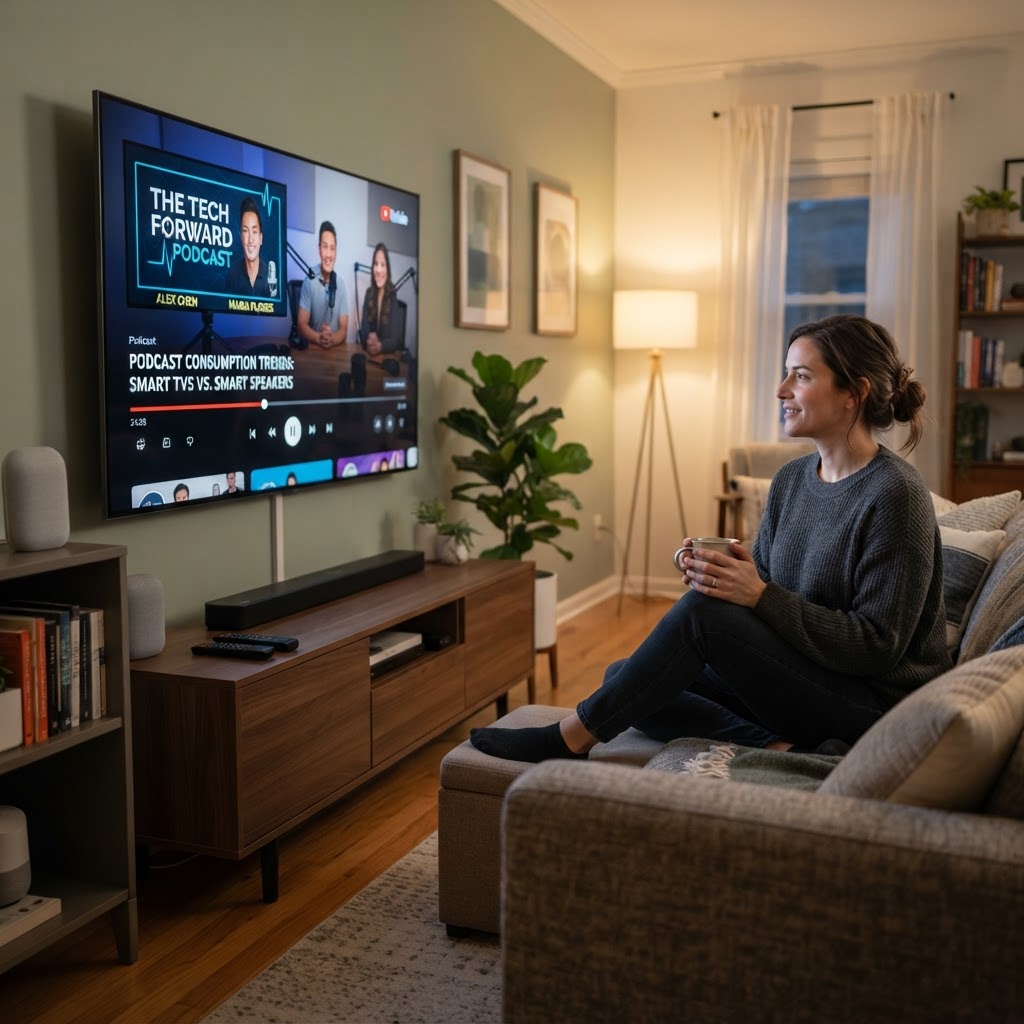
Smart TVs have emerged as a meaningfully more common podcast device than smart speakers, according to new data from Sounds Profitable. The gap is larger than many in the industry expected — and it carries direct implications for creators still optimizing primarily for voice-first or audio-only listening environments.
What the data actually shows
On September 9, 2026, Sounds Profitable published analysis drawn from The Podcast Landscape 2026, a recurring study of U.S. adult podcast consumption behavior. The numbers on device usage tell a clear directional story.
Smart TVs registered as the most-used podcast device for 12% of U.S. adults who have ever consumed a podcast — up from 8% in 2024 and 9% in 2025. Smart speakers, by contrast, came in at just 1% on the same primary-device measure in both 2025 and 2026.
The gap widens further when combining primary and secondary device usage. Sounds Profitable reports that smart TVs were named by 25% of podcast consumers across those two measures combined, while smart speakers reached only 3%.
To keep those figures in proper context: smartphones remain the dominant primary podcast device at 57% in 2026, with computers at 13%. Smart TVs at 12% are a rising third, not the overall leader. The story here is specifically the collapse of the smart speaker as a podcast surface — and the TV's quiet but consistent ascent in its place.
Why the smart speaker stalled
The smart speaker's decline in podcast consumption is worth examining on its own terms. These devices were heavily marketed through 2018–2020 as the next frontier for audio content discovery, with major platform investment in voice-first interfaces and skills ecosystems. That vision did not materialize in the podcast space.
By the time streaming video matured and smart TV operating systems became genuinely capable app platforms — supporting YouTube, Spotify, and other podcast-carrying services with full UI navigation — the living room screen had a structural advantage: it could serve both audio and video content in a single session, with no friction around visual search and browsing.
Podcast consumers, it turns out, prefer to browse. That is hard to do with a voice prompt.
The steady rise of the TV as a podcast surface
The three-year trend in the Sounds Profitable data — 8% in 2024, 9% in 2025, 12% in 2026 — is gradual but consistent. Each percentage-point gain represents a meaningful share of the U.S. adult podcast audience choosing a television as their go-to device.
This aligns with the broader expansion of video podcasting as a format. Creators who publish video episodes to YouTube or through Spotify's video layer are now reaching a segment of their audience on screens that are 55 inches wide and sit in shared living spaces. That is a fundamentally different consumption context than earbuds on a commute.
The implications for production are real. A thumbnail that reads clearly at 300 pixels may be illegible at 4K scale on a TV UI. An episode recorded in a dimly lit room with a consumer webcam looks noticeably worse when rendered at full living room resolution. These are solvable problems — but only for creators who know they need to solve them.
What this means for creators and businesses
Video podcasters should audit how their content appears inside TV-native apps, particularly YouTube on smart TVs and Spotify's television interface. Thumbnail legibility, episode title length, and channel art all render differently in a 10-foot viewing environment than in a mobile feed.
Studio operators and production companies serving podcast clients have a new conversation to have: production quality standards written for mobile-first distribution may not meet the expectations of an audience watching on a living room screen. 4K capture, controlled lighting, and clean audio-visual synchronization matter more as TV consumption grows.
Digital distributors and platform teams should pay close attention to how their TV apps handle discoverability. The 25% combined-device figure from Sounds Profitable suggests TV is already a meaningful secondary touchpoint for a large share of listeners — platform UI investment in that environment is warranted.
Media planners and advertisers thinking about podcast audience reach should factor in the TV context when evaluating host-read versus dynamically inserted ad formats. A listener watching on a television in a shared room is a different attention environment than a solo mobile listener.
PHQ perspective
The smart speaker never fully delivered on its podcast promise, and the data now makes that plain. What is more interesting is where the growth is going: not to a new voice interface or a wearable, but to the oldest screen in the home.
The living room television has effectively become a streaming-first computing surface for millions of households. Podcast platforms that invested early in quality TV app experiences — YouTube chief among them — are likely benefiting disproportionately from this shift. Platforms that treated TV apps as afterthoughts may find themselves underrepresented in a consumption context that is growing year over year.
For creators, the practical takeaway is not that mobile no longer matters — 57% primary device share makes clear that it does. The takeaway is that the floor for production quality is rising. An audience segment that is growing, engaged enough to seek out podcast content on a large screen, and likely watching in a shared environment deserves content that holds up visually. That is both a challenge and an opportunity for producers willing to invest in it.
The three-year upward trend in smart TV podcast consumption shows no sign of reversing. Creators and businesses that adapt now will be better positioned as that audience share continues to grow.
Exploring how device shifts affect your podcast distribution or production strategy? Browse PHQ's resources for podcasters for practical guidance on reaching audiences wherever they're listening — and watching.
Sources
- Sounds Profitable — Smart TV Killed the Smart Speaker Star (September 9, 2026): https://soundsprofitable.com/article/smart-tv-killed-the-smart-speaker-star
Sources
Primary reporting and supporting material used for this article.