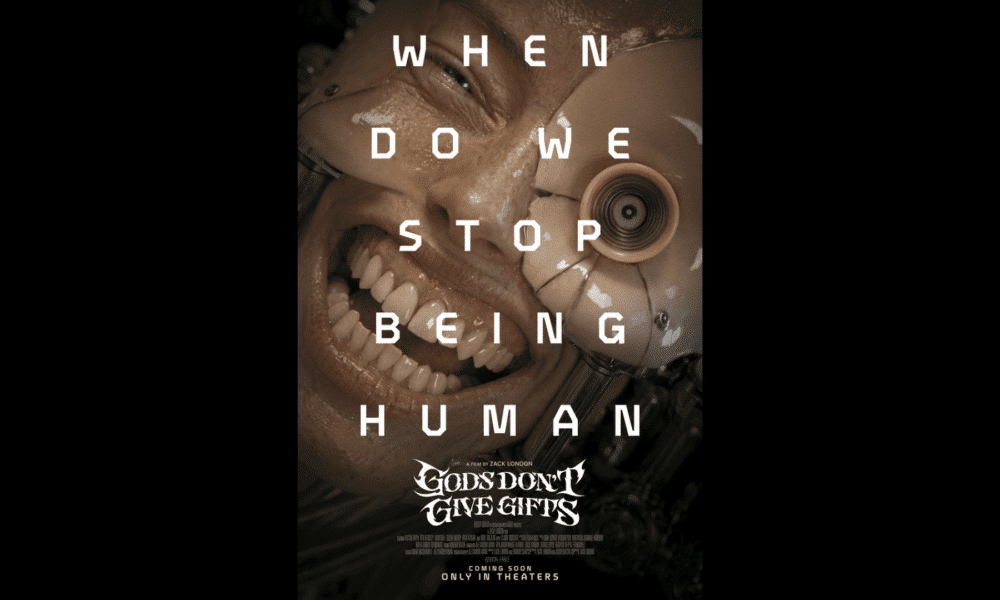
The creator-economy story around “Gods Don’t Give Gifts” is easy to reduce to one phrase: AI movie.
That would miss the more useful development.
AGC International has added the animated science-fiction feature to its sales and distribution slate. The film is the feature directorial debut of YouTube creator Zack London, known online as Gossip Goblin, whose channel has built a large audience around a science-fiction universe.
The project is scheduled for a U.S. theatrical release on December 4. According to reporting on the deal, the production used generative AI as part of a workflow that also included writers, artists, animators, voice actors, musicians, and conventional post-production.
The debate about AI filmmaking will continue.
For creators building businesses, another part of the story deserves equal attention:
A creator can use an audience to prove demand for an intellectual-property world before traditional entertainment distribution arrives.
The feed can function like a development lab
Traditional film and television development usually begins behind closed doors.
A concept is pitched.
Scripts are developed.
Executives evaluate market potential.
A pilot may be produced.
Audience proof arrives late.
Creators reverse that order.
They publish ideas directly.
Characters appear in Shorts.
World-building grows in public.
Fans reveal which stories they care about.
The creator learns from millions of micro-interactions before asking a distributor to take the project seriously.
That can create an unusual form of market research.
The platform audience is not a guarantee of theatrical success.
It is evidence that the underlying creative universe already has attention.
An audience is most valuable when it belongs to something
Follower count by itself is fragile.
A creator with 10 million followers who posts unrelated viral content may have less transferable intellectual property than a creator with a smaller audience built around a coherent world, character, genre, or point of view.
The difference is structure.
Can the audience explain what the creator makes?
Can a character exist outside one video?
Can a format become a series?
Can a story become a book, film, live event, game, or product?
Can another platform distribute it without destroying the identity?
Those are franchise questions.
Creators who want to build long-term media companies should begin asking them earlier.
The AI debate can obscure the role of the human team
Projects that use generative tools are frequently described as if a prompt produced the finished product.
That is not a useful production model.
A feature still needs:
- story structure
- direction
- performance
- continuity
- visual language
- music
- sound
- pacing
- editing
- quality control
- rights management
- audience strategy
- distribution
AI can change how some of those tasks are performed.
It does not remove the need for creative judgment.
This distinction matters for smaller creators considering AI video.
The tool can lower the cost of experimentation.
It cannot automatically create a compelling world.
Creator production economics are changing
Historically, ambitious visual storytelling required a large capital base before the first frame could be made.
Generative tools can reduce certain production barriers.
That may allow creators to prototype concepts that would have been economically impossible for them a few years ago.
A creator can test:
- a visual world
- a character
- an animation style
- a trailer
- a fictional advertisement
- a short narrative scene
- a proof-of-concept episode
Then use audience response to decide whether to invest further.
This can make development more iterative.
It can also create a flood of low-quality content.
The competitive advantage remains taste.
Traditional distribution still contributes something creators need
It is fashionable to say creators no longer need gatekeepers.
That is only partly true.
A platform account can reach millions of people without a television network.
Traditional distribution can still provide:
- theatrical access
- international sales
- financing relationships
- awards infrastructure
- press
- rights expertise
- marketing coordination
- retail or streaming negotiations
The creator economy is therefore not necessarily replacing traditional media.
The two systems are becoming more interoperable.
Creators bring audience, speed, cultural feedback, and IP.
Traditional companies bring distribution machinery, capital, and institutional access.
The most interesting deals combine those advantages.
Podcasters should pay attention even if they never make a film
Podcasting has already produced books, television adaptations, documentaries, tours, live events, and scripted projects.
The lesson is not that every host should become a filmmaker.
It is that a show can be more than an episode feed.
A local business interview series can become an event.
A narrative podcast can become a book or documentary.
A founder show can become a conference.
A children’s audio property can become animation.
A healthcare show can become an educational library.
A creator should understand what intellectual property is accumulating through repeated production.
World-building applies to business content too
Businesses may hear “world-building” and think fantasy fiction.
The same principle can be practical.
A brand creates a repeatable universe when it develops:
- recognizable visual environments
- recurring experts
- named segments
- consistent language
- recurring questions
- a distinct editorial lens
- audience rituals
- a recognizable production style
Those elements make the content feel like a property rather than a series of marketing posts.
A podcast studio set can become part of the brand.
A recurring field segment can become part of the brand.
A signature interview question can become part of the brand.
Consistency creates recognition.
Short-form content should sometimes point toward something larger
Many creators optimize every post for immediate performance.
Did it get views?
Did it get shares?
Did it convert?
Those questions matter.
They can also encourage disconnected production.
A more strategic creator may use some posts to build a larger asset.
Introduce a recurring character.
Establish a subject.
Test a new series.
Build a narrative arc.
Train the audience to care about a world.
That means an individual video can be valuable even when it is not the highest-performing post of the month.
It may be doing franchise work.
PHQ Insights: what this means for creators and clients
For creators: Ask what your content is building beyond the next view. A repeatable world, format, or character can become an asset.
For podcasters: Treat strong recurring segments and show identity as intellectual property with expansion potential.
For businesses: Build recognizable content systems instead of producing unrelated promotional videos.
For producers: AI can accelerate development, but creative direction, rights, performance, and editorial judgment remain core production functions.
A practical IP audit for creators
Look at your last 50 pieces of content.
Which ideas repeated?
Which characters or guests created outsized response?
Which visual settings became recognizable?
Which phrases did the audience repeat back?
Which format could another person describe without seeing the title?
Which topic has enough depth for 20 more episodes?
Those patterns may contain more long-term value than the single highest view count.
Document them.
Name them.
Develop them deliberately.
The next studio model may be creator-first
A traditional production company begins with projects and seeks audiences.
A creator-first studio may begin with audiences, build multiple properties around them, and then move the strongest concepts into larger formats.
That can include podcasts, video series, documentaries, books, courses, live events, and eventually film or television.
The creator is not simply talent hired into somebody else’s property.
The creator can become the development company.
That is the structural shift worth watching.
What to watch next
The theatrical performance of “Gods Don’t Give Gifts” will matter more than its trailer views when evaluating how transferable the audience really is.
The reception will also influence the debate around generative production.
But the creator-economy lesson already exists.
Platforms are becoming places where intellectual property can be built, tested, and de-risked in public.
Creators who understand that will stop thinking only about posts.
They will start thinking about properties.
Sources
Primary reporting and supporting material used for this article.