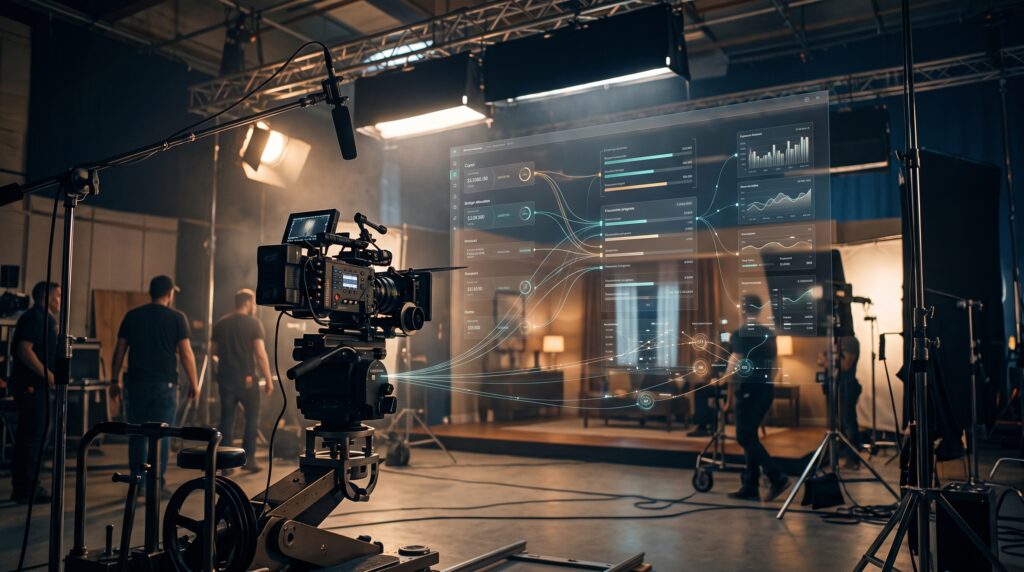
The camera can keep rolling after the budget has already gone wrong.
That is the problem Miami-based Q Intelligence is trying to attack.
The startup, founded by Olivier French and Aleksandre “Sandro” Kokhreidze, is building what it describes as a financial operating system for film and television production.
Refresh Miami reports that Q estimates production cost reports can arrive five to seven days late and that typical overruns can reach 20% to 40%. Those are company estimates, not an industry-wide audited benchmark, but anyone who has worked in production recognizes the underlying problem: money can move faster than reporting.
A location day happens.
Crew overtime accumulates.
A schedule slips.
Equipment stays longer.
A scene is reshot.
By the time the financial picture catches up, the creative decision has already been made.
Production is not only a creative system. It is a real-time operating system.
Film has unusually complicated money movement
A film can combine:
- private financing
- tax incentives
- bank facilities
- payroll
- escrow
- vendors
- talent
- insurance
- location costs
- post-production
The budget is not simply “how much the movie costs.”
It is also when money moves, who approves it, which incentive applies, what has already been committed, and how changes affect the remaining shoot.
Q says it wants to sit above existing production systems and connect budgeting, incentives, payments, controls, and reporting rather than replace every tool.
That layer is valuable because a producer needs a current picture.
Independent creators have the same problem at smaller scale
A YouTube creator may not have a $20 million production budget.
They can still lose money through delayed information.
A branded video was quoted at $4,000.
Then:
- one extra edit day is added
- the location extends
- a prop needs replacement
- a freelancer works overtime
- travel changes
- the brand requests additional versions
The project invoices for $4,000.
The true cost becomes $4,600.
Revenue looked healthy.
Margin disappeared.
If the creator does not know until the month closes, the pricing mistake repeats.
Studios need job-level economics
A production company should be able to answer:
- What did this project sell for?
- What labor did it use?
- What equipment cost was allocated?
- What edit time did it consume?
- Were revisions inside scope?
- What was gross margin?
- Which add-ons were profitable?
- Which client behavior created overage?
Without job-level data, pricing becomes intuition.
That can work at small scale.
It becomes dangerous as volume grows.
Real-time visibility changes creative decisions
Good financial controls do not have to kill creativity.
They can protect it.
Imagine a producer learns halfway through a shoot that the day is trending 12% over budget.
They still have options.
Cut a low-priority setup.
Move a scene.
Reduce overtime.
Simplify a location change.
Use existing b-roll.
If the same information arrives a week later, those options are gone.
The purpose of operational intelligence is not to tell creatives “no.”
It is to make the tradeoff visible while the decision can still change.
Tax incentives are becoming part of production strategy
Q is starting with a product around tax incentives, according to Refresh Miami.
That is timely for South Florida.
Florida and local jurisdictions continue to debate and develop ways to attract film and entertainment production.
For larger productions, incentives can materially affect where a project shoots.
But incentives are operationally complex.
Qualification, documentation, eligible spend, timing, and compliance matter.
Technology that makes those economics easier to model can make a region more competitive.
The opportunity is not only “bring Hollywood to Miami.”
It is make Miami easier to produce in.
South Florida has the ingredients for production-tech businesses
Miami sits at an intersection of:
- finance
- Latin America
- entertainment
- technology
- luxury
- hospitality
- creator media
That makes it a logical place to build tools serving media commerce.
The city does not need to become Los Angeles to matter in production.
It can develop expertise around the systems supporting production.
Finance.
Distribution.
Localization.
Creator tools.
Studios.
Events.
Cross-border media.
Those are defensible niches.
Q is also an example of the human-in-the-loop model
French told Refresh Miami that the goal is not to automate the producer out of the process.
That is a useful distinction.
AI can surface budget risk.
It cannot automatically understand every creative priority.
A producer may knowingly overspend on the final scene because it carries the film.
A business may invest more in one flagship episode because the guest is strategically important.
The tool should make the cost visible.
The person decides whether the trade is worth it.
That is where AI is often most useful in creative operations.
Funding is still early
Refresh Miami reports that Q is raising a $250,000 bridge SAFE followed by a planned $2.5 million seed round, while preparing initial pilot programs.
That means the company is still in an early stage.
The vision is larger than the proven product.
It is important not to confuse a roadmap with deployed scale.
The startup now has to prove that production teams will adopt another financial layer and that the promised visibility creates measurable savings or better decisions.
PHQ Insights: what this means for creators and clients
For creators: Know project margin before you scale production. Revenue growth can hide operational leaks.
For studios: Track revisions, edit hours, crew time, and add-on costs at the job level.
For brands: A clear production budget protects both creative ambition and the client relationship.
For South Florida producers: Financial infrastructure and incentive expertise can become competitive advantages alongside locations and talent.
Every creative business needs a postmortem
After a project closes, review:
What was quoted?
What actually happened?
Which tasks exceeded estimate?
What did the client change?
Which production choices added value?
Where was time wasted?
What should be priced differently next time?
That feedback makes the next project smarter.
Creative teams often avoid financial review because it feels separate from the work.
It is part of the work.
The best production system makes tradeoffs visible
A producer should be able to say:
“If we add this third location, it adds $2,800 and three hours.”
Then the creative and client can decide.
The worst system discovers the cost after delivery.
That is the broader lesson in Q Intelligence’s thesis.
Production does not become less creative when the numbers are current.
It becomes more intentional.
Production finance belongs in pre-production
The cheapest time to control production cost is before the crew arrives.
A strong pre-production budget should connect money to decisions:
How many locations?
How many cameras?
How much crew?
How many shooting hours?
What happens if the schedule runs long?
How many revision rounds are included?
Which assets are required at delivery?
What is optional if the budget tightens?
That creates a hierarchy.
When reality changes—as it always does—the producer knows what can move without damaging the core objective.
Independent creators can use the same discipline. Before a shoot, separate “must have” from “nice to have.” Price both. Build a small contingency. Confirm who pays for client-requested scope changes.
That is not corporate bureaucracy.
It protects the creative priority.
A team that knows what the flagship scene, essential camera angle, or primary deliverable is can preserve it while trimming lower-value complexity elsewhere.
Real-time financial information becomes most powerful when the project already has clear priorities.
What to watch next
Q expects to begin with tax-incentive functionality and move toward approvals, escrow, payments, reporting, and intelligence for financiers and insurers.
The roadmap is ambitious.
If it works, it could make a traditionally fragmented production-finance process more legible.
For independent media companies, the immediate takeaway does not require new software.
Know the numbers while the camera is still rolling.
That is when the information can actually save the production.
Sources
Primary reporting and supporting material used for this article.