
The podcasting world has never been more vibrant — or more competitive. With over 4 million podcasts currently available and listenership continuing to climb year over year, creators are constantly looking for ways to stand out and connect with their audiences. One of the most fundamental decisions you'll make as a podcaster isn't about your niche or your guest list — it's about format. Should you launch an audio-only show, or go all-in on video?
This audio vs video podcast comparison might seem straightforward on the surface, but the right answer depends on far more than personal preference. Your audience, your content goals, your budget, and even your personality on camera all play a role. Whether you're a first-time podcaster trying to find your footing or an established creator looking to evolve your show, understanding the strengths and limitations of each format is the first step toward making a decision you'll feel confident about for the long haul.
In this guide, we'll break down both formats honestly and thoroughly — covering production realities, audience behavior, marketing implications, and more — so you can choose the path that genuinely fits your vision.
What Is an Audio-Only Podcast?
An audio-only podcast is exactly what it sounds like: a recorded show distributed exclusively in sound. Listeners tune in through platforms like Spotify, Apple Podcasts, or Amazon Music, consuming content during commutes, workouts, household chores, or any moment when their eyes are occupied but their ears are free.
Audio podcasting is the format that built the medium as we know it. Even today, the vast majority of podcast consumption happens through audio-only listening, and many of the most successful shows in the world — from Serial to How I Built This — have never needed a camera to build massive, loyal audiences.
Pros of Audio-Only Podcasting
Lower production costs and simpler logistics. Recording a high-quality audio podcast requires a solid microphone, good acoustics, and basic editing software. The barrier to entry is significantly lower than video, making it accessible for solo creators and small teams alike.
Flexibility for listeners. Audio is a passive medium in the best possible way. Your audience can listen while driving, exercising, or cooking — moments when video simply isn't an option. This accessibility expands your potential reach considerably.
Faster production cycles. Without the added complexity of video editing, color correction, or b-roll, audio episodes can be produced and published much more quickly. For creators on a consistent release schedule, this efficiency matters.
Intimate connection. There's something uniquely personal about a voice in your ear. Audio podcasts often foster a deep sense of connection between host and listener that can be harder to replicate on screen.
Cons of Audio-Only Podcasting
No visual differentiation. In a crowded landscape, audio-only podcasts rely entirely on thumbnails, show notes, and word-of-mouth to attract new listeners. Without video clips to share across social media, discoverability can be more challenging.
Limited content repurposing. Audio content can be transcribed and clipped, but it doesn't translate as naturally to platforms like Instagram Reels, TikToks, or YouTube Shorts — channels that are increasingly essential for podcast growth.
What Is a Video Podcast?
A video podcast — sometimes called a "vodcast" or, more commonly now, a podcast recorded on camera — captures the full visual experience of a recording session. These are distributed on platforms like YouTube, often simultaneously with an audio version on traditional podcast directories.
Video podcasting has surged in popularity, driven in large part by YouTube's aggressive push into the podcast space and audience data showing that many listeners actually watch their favorite shows rather than just listening. Spotify has also invested heavily in video podcast support, signaling that this format is far from a passing trend.
Pros of Video Podcasting
Greater audience engagement. Seeing your host's expressions, body language, and studio environment adds a layer of connection that audio simply can't replicate. Viewers often report feeling more engaged and more trusting of on-camera personalities.
Massive content repurposing potential. A single video recording session can yield dozens of pieces of content — full episodes, short clips, reaction moments, highlight reels — all optimized for different platforms. For podcasters building a brand, this multiplier effect is invaluable.
YouTube discoverability. YouTube is the world's second-largest search engine. Publishing your podcast there means you're searchable in a way that audio-only platforms don't fully support. New listeners can find you through search, recommendations, and trending content.
Sponsorship and monetization opportunities. Brands often pay a premium for video placement, and the visual nature of the format allows for more natural product integrations.
Cons of Video Podcasting
Higher production demands. Quality video requires cameras, lighting, professional-grade audio and video editing, set design, and often a dedicated production team. The logistical lift is considerably greater.
Studio or space requirements. Recording video at home is possible, but a cluttered background or inconsistent lighting can undermine your brand credibility quickly. Many creators opt for a professional studio environment precisely because the visual stakes are higher.
On-camera comfort. Not every great podcast host is a natural on camera. The presence of a lens can alter delivery, create self-consciousness, and change the dynamic of a conversation in ways that take time to overcome.
Audio vs. Video Podcast: Key Comparisons
Audience Preferences
Understanding your audience is everything. Younger demographics — particularly 18 to 34-year-olds — tend to gravitate toward video content and are more likely to discover podcasts through YouTube or social clips. Meanwhile, older or more niche audiences may strongly prefer audio, especially if they're regular users of traditional podcast apps. If you're unsure, survey your existing audience or look at where your competitors' listeners are most engaged.
Production and Editing Considerations
Audio editing is largely about cleaning up sound — removing background noise, balancing levels, cutting dead air, and sometimes adding music or effects. Video editing includes all of that plus syncing audio tracks, cutting visually, adding graphics, and producing a polished visual product. Plan your time accordingly. A 30-minute audio episode might take 1–2 hours to edit; the video equivalent can easily take 4–6 hours or more without professional support.
Equipment and Studio Requirements
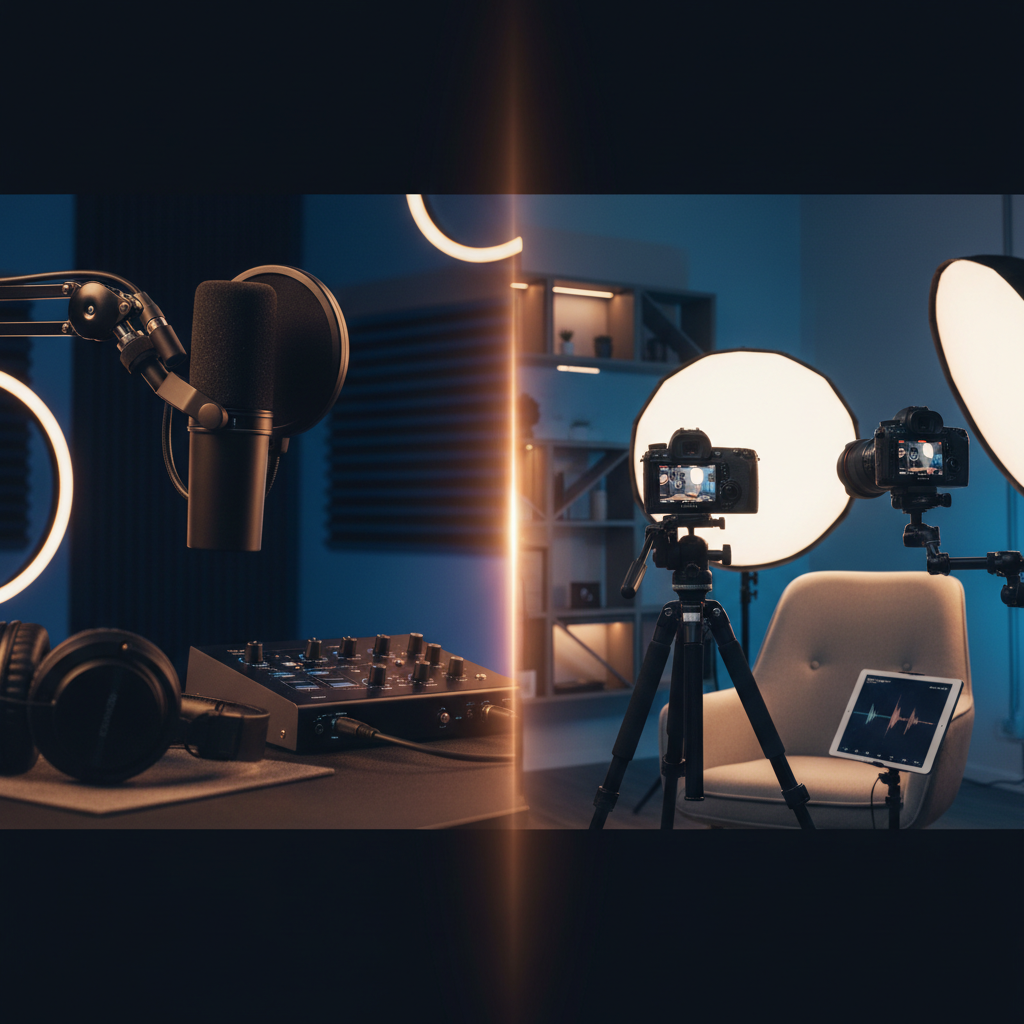
For audio, a quality condenser or dynamic microphone, a simple audio interface, and good acoustic treatment are the fundamentals. For video, you'll add cameras (ideally multiple angles), professional lighting setups, and a visually appealing backdrop. Podcast HQ's studios in Hollywood, Aventura, and Wynwood are built to accommodate both formats — fully equipped so you can show up and focus on your content rather than your gear.
Marketing and Distribution Strategies
Audio podcasts live and die by their presence on Spotify, Apple Podcasts, and their RSS feed. Video podcasts have those channels plus YouTube, Instagram, TikTok, and LinkedIn. The marketing strategy for a video podcast is inherently more cross-platform — which is both an opportunity and an added responsibility.
How to Choose the Right Format for Your Podcast
Assess Your Target Audience
Where does your ideal listener spend their time? If they're commuters or gym-goers, audio may be the perfect fit. If they're scrolling YouTube or engaging on social media, video will help you reach them more naturally. Don't guess — research.
Identify Your Content Goals
Are you trying to educate, entertain, build a personal brand, or generate leads for a business? Educational content often performs well in both formats, but thought leadership and brand-building tend to benefit from the credibility that on-camera presence provides. Interview shows with notable guests can generate significant video engagement, while deeply researched narrative shows may feel more natural in audio.
Consider Your Budget and Resources
Be honest with yourself. Launching a video podcast on a shoestring budget often results in content that looks worse than audio-only alternatives — and that can hurt your brand. If resources are limited, start strong with audio, build your audience, and scale into video when you're ready. Many successful shows have followed exactly this path.
It's also worth noting that you don't have to choose forever. Some podcasters start audio-only and add video later. Others record video but release audio-only initially, building the video component into their growth strategy. Flexibility is your friend.
How Podcast HQ Can Support Both Formats
Regardless of which format you choose, having the right environment makes a meaningful difference in your output quality and your confidence as a creator. Podcast HQ's purpose-built studios are designed for exactly this — whether you're recording a solo audio show or a multi-camera video production with guests.
Members have access to professional equipment, dedicated engineering support, and editing assistance that scales with your needs. For creators still weighing their format options, a studio session can actually be a great way to test both approaches before committing — seeing how you perform on camera, how your guests interact in a professional space, and how the recorded product looks and sounds can clarify your decision faster than any comparison guide.
Conclusion
There's no universally correct answer in the audio vs video podcast comparison — only the answer that's right for your show, your audience, and your goals. Audio podcasting offers accessibility, intimacy, and a lower barrier to entry. Video podcasting offers visual engagement, content versatility, and significant discoverability advantages. The best format is the one you can execute consistently, professionally, and in a way that genuinely serves your listeners.
Take stock of where your audience lives, what your content calls for, and what your resources realistically allow. Then commit — and create.
Ready to start your podcasting journey? Whether you're going audio-only or stepping in front of the camera, book a session with Podcast HQ today and let's build something worth listening to — and watching.