
A Comprehensive Guide to Starting Your Podcast in 2026
If you've been thinking about launching a podcast, there has never been a better time to hit record. Podcasting has exploded from a niche hobby into a global media powerhouse, and in 2026, it shows absolutely no signs of slowing down. With over 500 million podcast listeners worldwide and new shows launching every single day, the medium has cemented itself as one of the most powerful ways to share ideas, build authority, and connect with an audience that actually cares about what you have to say.
Whether you're a entrepreneur looking to grow your brand, a storyteller with something important to share, or simply someone who wants to join the conversation in your industry — starting a podcast in 2026 is one of the smartest moves you can make. This guide will walk you through everything you need to know, from concept to launch, with practical advice that meets you right where you are as a beginner.
Understanding the Podcast Landscape in 2026
Before you press record, it helps to understand the world you're stepping into.
Current Trends Shaping Podcasting
Podcasting in 2026 is smarter, more visual, and more competitive than ever. AI-powered transcription and editing tools have dramatically lowered the production barrier, meaning listeners have higher expectations for audio quality than they did just a few years ago. Simultaneously, video podcasting has gone from a nice-to-have to an industry standard. Platforms like YouTube, Spotify, and even TikTok are prioritizing video podcast content, giving creators more distribution channels and audiences more ways to tune in.
Short-form podcast clips — think 60 to 90-second vertical video highlights — are driving massive discovery on social media. If you're not thinking about your podcast as a multi-format content machine, you're leaving serious growth on the table.
Popular Genres and Types of Podcasts
The good news? There's an audience for virtually every topic. Some of the fastest-growing categories in 2026 include:
- True crime and investigative journalism
- Business, entrepreneurship, and personal finance
- Health, wellness, and mental health
- Education and self-improvement
- Niche hobbies (everything from vintage watches to urban gardening)
- Local and community-focused content
That last category is particularly exciting. South Florida, for example, has a booming creator economy with stories worth telling — and a growing audience ready to listen.
Defining Your Podcast Concept
A great podcast doesn't start with equipment. It starts with clarity.
Identifying Your Niche and Target Audience
The biggest mistake beginners make is trying to appeal to everyone. The most successful podcasts are laser-focused. Ask yourself:
- Who is my ideal listener? Be specific. "Women in their 30s navigating career changes" is far more actionable than "everyone interested in work."
- What problem do I solve or what experience do I create? Are you educating, entertaining, inspiring, or some combination?
- What makes my perspective unique? Your lived experience, your access to guests, your local angle — lean into what only you can offer.
Crafting a Compelling Podcast Title and Description
Your title and description are your first impression in every podcast directory. Keep your title concise, memorable, and ideally keyword-friendly. Your description should answer three questions immediately: What is this show about? Who is it for? Why should I listen?
Avoid vague descriptions like "a show about life." Instead, try something like: "The Miami Entrepreneur Podcast gives South Florida business owners the strategies, stories, and connections they need to scale smarter."
Planning Your Content Structure
Decide on your format before you record episode one:
- Solo shows — Just you, sharing your expertise or perspective
- Interview format — Guest conversations that bring in new voices each episode
- Co-hosted shows — Two or more hosts creating chemistry and dialogue
- Narrative/storytelling — Scripted, produced stories with a journalistic feel
Also determine your episode length and publishing cadence. Consistency beats perfection every time. A weekly 20-minute episode you can actually sustain will outperform a biweekly hour-long show you burn out on after month two.
Essential Equipment and Software for Beginners
You don't need to spend thousands of dollars to sound professional — but you do need the right tools.
Recommended Microphones and Headphones
For beginners, a solid USB microphone is the sweet spot of quality and simplicity. Top picks in 2026 include:
- Shure MV7+ — A podcaster's workhorse with both USB and XLR connectivity
- Blue Yeti X — Excellent sound quality with easy plug-and-play setup
- Rode NT-USB Mini — Compact, studio-quality, and beginner-friendly
Pair your mic with closed-back headphones like the Sony MDR-7506 or Audio-Technica ATH-M50x so you can monitor your audio accurately while recording.
Editing Software for New Podcasters
- Descript — An AI-powered editor that lets you edit audio by editing text. Ideal for beginners in 2026.
- Adobe Audition — Professional-grade with a learning curve, but worth it as you grow.
- Audacity — Free, open-source, and surprisingly capable for basic editing.
- Riverside.fm — Great for remote recording with guests, with built-in video capabilities.
Podcast Hosting Platforms
Your podcast needs a hosting platform to distribute your RSS feed to directories. Reliable options include Buzzsprout, Podbean, Transistor, and Spotify for Podcasters. Most offer free tiers to get started, with analytics dashboards to track your growth.
Setting Up Your Recording Space
Even with premium equipment, a bad recording environment will tank your audio quality.
The Importance of Acoustics and Soundproofing
Sound bounces off hard surfaces like walls, floors, and ceilings — creating echo and reverberation that makes your podcast sound amateurish. The goal is to add absorption. Practical at-home solutions include:
- Recording in a closet surrounded by hanging clothes
- Adding a thick rug and heavy curtains to your recording area
- Using acoustic foam panels or moving blankets on walls
- Positioning your mic closer to your mouth (6 to 8 inches is a good starting point)
How Podcast HQ Offers Professional Recording Spaces
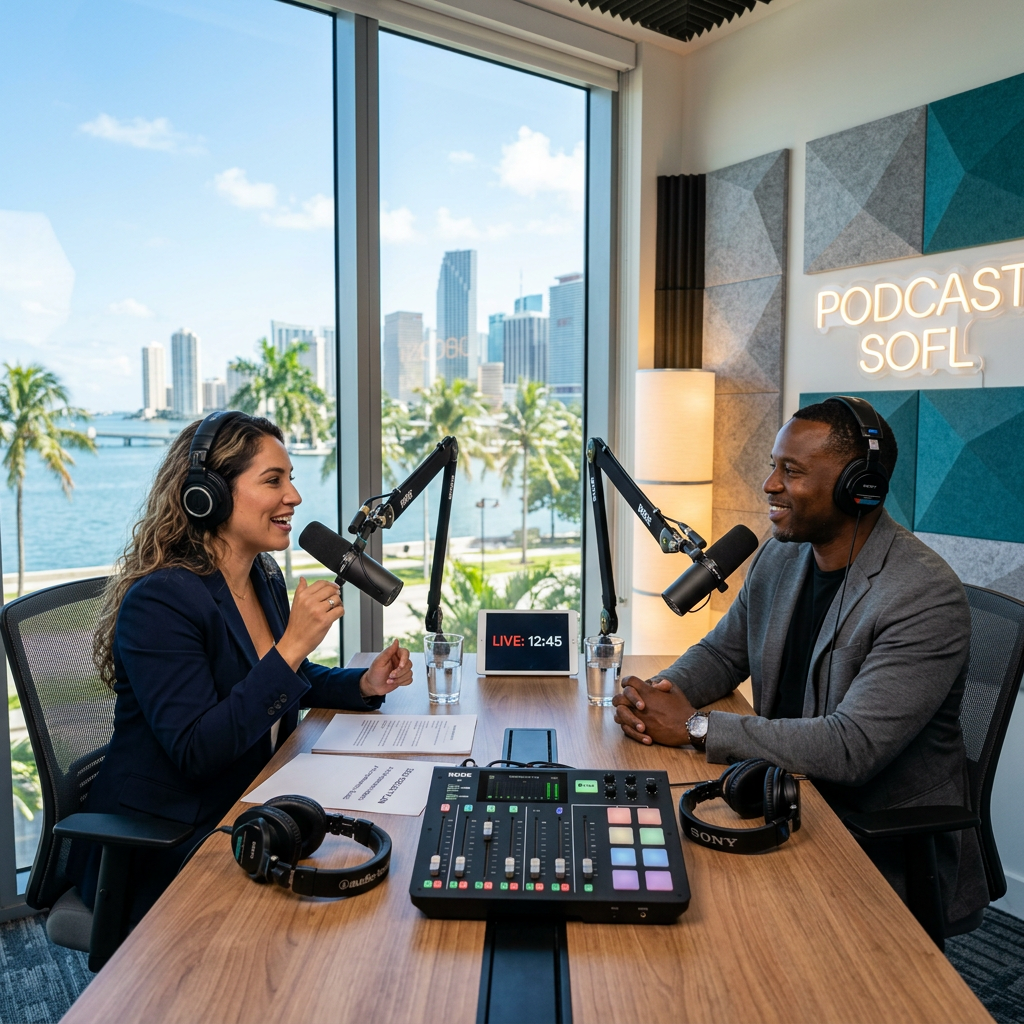
If you want to skip the DIY acoustics challenge entirely, recording at a professional studio is a game-changer. At Podcast HQ in South Florida, our purpose-built recording studios are acoustically treated, fully equipped, and designed specifically for podcast production. Whether you're recording your first episode or bringing in a high-profile guest, you'll sound like you've been doing this for years — because the environment is doing the heavy lifting for you.
Our studios also offer video podcast setups, so you can capture broadcast-quality footage for YouTube and social media in the same session. Explore our studio spaces and booking options here.
Recording and Editing Your First Episode
You've planned, you've prepared — now it's time to actually make something.
Step-by-Step Guide to Recording
- Prepare an outline, not a script. Fully scripted shows often sound stiff. A clear outline keeps you on track while allowing natural conversation.
- Do a sound check. Record 30 seconds, play it back, and check your levels. Aim for audio peaking around -12dB to -6dB.
- Record in a single, quiet session. Turn off notifications, close windows, and let anyone nearby know you're recording.
- Don't stop for small mistakes. Keep going and edit them out later. Pausing and restarting breaks your flow.
- Record a short intro and outro separately. These polish your final product without requiring perfection on your first take.
Editing Best Practices
- Remove long silences, filler words ("um," "uh"), and false starts
- Apply light noise reduction to remove background hum
- Normalize your audio so volume is consistent throughout
- Add your intro music, outro music, and any ad breaks
- Export as MP3 at 128kbps for mono or 192kbps for stereo
Tips for Staying Calm and Confident
First-episode nerves are completely normal. Remember: your first listener is future-you hitting play during editing. The audience comes later. Talk to one person, not a crowd. Imagine your ideal listener sitting across from you and have that conversation. Confidence grows with repetition — just start.
Publishing and Promoting Your Podcast
Creating great content is only half the equation. People have to find it.
Choosing Podcast Directories for Distribution
Once your episode is on your hosting platform, submit your RSS feed to the major directories:
- Apple Podcasts (iTunes)
- Spotify
- Amazon Music / Audible
- iHeartRadio
- YouTube Podcasts
Approval can take a few days for some platforms, so submit early. Most hosting platforms now offer one-click distribution to streamline this process.
Creating Show Notes and Episode Art
Show notes serve double duty: they help listeners know what to expect and they create SEO-friendly content on the web. Include a brief episode summary, key takeaways, guest bios, and any links mentioned.
Your cover art is your billboard. It should be clean, readable at small sizes (3000x3000 pixels is standard), and reflect your brand personality. Don't underestimate this — listeners absolutely judge podcasts by their artwork.
Marketing Your Podcast
- Clip and share — Pull 60 to 90-second highlight clips for Instagram Reels, TikTok, and YouTube Shorts
- Engage in communities — Facebook groups, Reddit threads, and LinkedIn communities related to your topic
- Collaborate — Guest on other podcasts in your niche to borrow existing audiences
- Email list — Even a small email list gives you a direct line to your most loyal listeners
- Consistency — Showing up regularly builds trust and algorithmic favor on every platform
Monetization Options and Growth Strategies
Yes, you can make money podcasting — but approach it strategically.
Introduction to Podcast Monetization Methods
- Sponsorships and host-read ads — Typically unlocked once you hit 1,000+ downloads per episode, but niche shows can attract sponsors sooner
- Listener support — Platforms like Patreon and Buy Me a Coffee let your audience fund you directly
- Premium content — Bonus episodes, ad-free feeds, and exclusive content for paying subscribers
- Courses and products — Your podcast as a funnel for your own services, coaching, or digital products
- Live events — Meetups, live recordings, and ticketed events that deepen community connection
Building a Community Around Your Podcast
The podcasts that last are the ones that build real relationships. Create a dedicated community space — a Discord server, a Facebook group, or even a newsletter — where listeners can connect with you and each other. Ask for listener questions, feature audience voices, and make your community feel like insiders.
How Podcast HQ Supports Your Growth
At Podcast HQ, we don't just offer recording studios — we offer an ecosystem for podcasters at every stage. Our membership options give ongoing creators access to studio time, production support, and a community of fellow podcasters in South Florida who are building something meaningful. Whether you need a one-time session or a long-term home for your show, we're here to help you grow. Learn more about our membership benefits here.
Conclusion
Starting a podcast in 2026 is one of the most accessible, rewarding, and impactful things you can do as a creator, business owner, or storyteller. The technology has never been more beginner-friendly, the audiences have never been more engaged, and the opportunity to carve out your own corner of the audio world has never been more real.
Here's a quick recap of your roadmap:
- Define your niche, audience, and format before anything else
- Invest in the right gear and recording environment
- Record consistently and edit with intention
- Distribute to every major directory and promote actively
- Monetize and grow by building genuine community around your show
The hardest episode you'll ever record is episode one — not because it's the most technically challenging, but because it requires you to start before you feel ready. So start anyway. Every great podcaster you admire was once sitting exactly where you are right now.
Ready to start your podcast journey? Book a session at Podcast HQ today and record your first episode in a professional, fully equipped studio designed to make you sound your absolute best. Book your studio session here. Our team is ready to help you go from idea to launch — and beyond.