
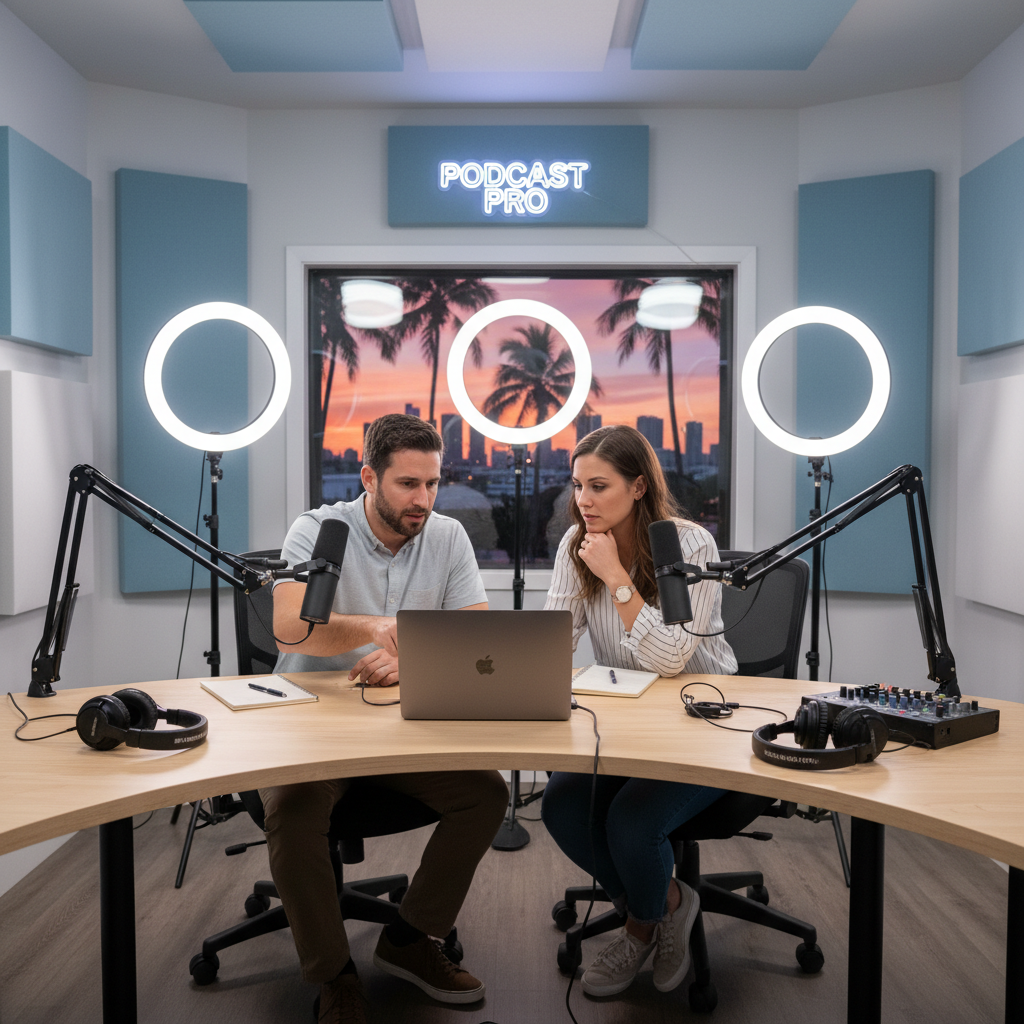
You've done your research. You've listened to enough shows to know what you want to create, and you're serious enough to be worried about getting it wrong. That's actually a good sign — the podcasters who struggle most aren't the ones who overthink the launch, they're the ones who hit record before they have any real foundation in place. If you're searching for common podcast mistakes beginners make before you publish episode one, you're already ahead of most people who start this process. Here's what we actually see in the studio, from hosts at every level, and exactly how to avoid the traps that quietly sink most new shows.
Mistake #1: Recording in the Wrong Environment Before Worrying About Gear
This is the one that surprises new podcasters most, and it has the biggest impact on audio quality by a significant margin.
Room acoustics are the invisible variable that most beginner content skips entirely. The microphone gets all the attention — the reviews, the YouTube comparisons, the Reddit threads — but the room your voice is recorded in shapes the sound far more than the hardware capturing it. Hard surfaces (bare walls, wood floors, glass windows) create reflections. That reflection reaches your microphone milliseconds after your direct voice signal does, and the result is a subtle reverb that makes recordings sound amateurish, distant, or simply exhausting to listen to for extended periods.
The technical term is "room echo," but the listener experience is simpler: it just sounds bad. Not bad in a way most listeners could diagnose, but bad in a way they respond to — by turning it off.
The fix doesn't require a full studio build. A walk-in closet with clothes on the racks is one of the most effective recording environments available to a beginner — the fabric absorbs reflections naturally. A furnished bedroom with carpeting, curtains, and a bed works well. If you're recording in a sparse room, moving a few blankets, bookshelves, or soft panels into the space makes a real, measurable difference.
What doesn't fix the problem: a better microphone. We've had clients come into our studio after months of recording in untreated spare rooms with $300 microphones, and the contrast when they record in a properly treated space is immediate. Same voice, completely different result.
If treating your space isn't realistic, the straightforward solution is to book a professionally treated recording room for your sessions. The environment does the heavy lifting so you don't have to.
Mistake #2: No Episode Plan Before Hitting Record
There's an important difference between scripting an episode and planning one — and most beginners either do neither or swing too far in the wrong direction.
A fully scripted episode sounds like someone reading. The pacing flattens. The natural breathing and thought patterns that make a host compelling to listen to get ironed out. But recording with no structure at all produces something equally difficult to listen to: the rambling intro that takes four minutes to arrive at the actual topic, the repeated "um, where was I going with that," the episodes that clock in at forty-five minutes when the content genuinely warranted twenty.
The solution is an outline, not a script. Before you record, write one sentence that defines the specific goal of the episode — what should the listener know, feel, or be able to do by the end? Then list three to five core points that build toward that goal. Write a deliberate open (what the episode covers and why it matters) and define how you'll close it.
That's the framework. It takes fifteen minutes to build, and it makes the recording faster, tighter, and far more listenable. The host sounds prepared without sounding rehearsed.
Mistake #3: Treating the Release Schedule as Optional
Podcast listeners are subscribers. That's a word worth sitting with — they have opted into a recurring relationship with your show. That relationship only works if the show actually recurs.
The rationalization almost every beginner reaches for at some point is: "I'll release when I have something worth saying." It's reasonable-sounding logic that is, in practice, a momentum killer. Audiences don't wait. They shift their attention to shows that show up on a predictable schedule. Algorithms on platforms like Spotify and Apple Podcasts factor in publishing consistency. And your own motivation — which will get tested, especially in the early months when numbers are quiet — stays more stable when you've committed to a cadence rather than leaving it open-ended.
A podcast consistency schedule doesn't have to be aggressive. One episode every two weeks is entirely defensible for a solo host balancing other work. What matters is the commitment: decide on the cadence before you launch, treat it like a professional deadline, and protect it with the same discipline you'd apply to a client meeting.
The shows that gain traction are almost always the ones that were simply still there when the listener went looking.
Mistake #4: Ignoring Podcast Artwork and Show Notes
Your cover art is your first impression in every podcast directory — Apple, Spotify, Amazon, Google. It appears in search results, in "New and Noteworthy" sections, and in the notifications your listeners receive when a new episode drops. At that scale, it is a billboard.
Bad artwork communicates something specific: it tells a potential listener that the production value inside the episode is probably consistent with the production value on the outside. A blurry headshot in a generic template, a font that's too small to read at thumbnail size, a color palette that doesn't stand out on a dark background — these are small details that carry outsized weight in a crowded directory.
Show notes are a separate issue with a dual function that most beginners underestimate. They're a resource for your current listeners (links, references, guest bios) and an SEO surface for potential listeners who are searching for content in your niche. A show notes page that contains the episode topic, a few well-written paragraphs of context, timestamps, and relevant links gives search engines something to index and gives potential listeners the context to decide whether this episode is worth their time.
None of this needs to be elaborate. It needs to be intentional.
Mistake #5: Over-Investing in Gear, Under-Investing in Process
The gear trap is one of the most common podcast mistakes beginners fall into, and it's easy to understand why. Equipment is concrete, shoppable, and feels like progress. Process is abstract, requires trial and error, and takes longer to see results from.
A $400 microphone in an untreated spare bedroom with hard floors and bare walls will sound noticeably worse than a $100 microphone — something like a Shure MV7 or an Audio-Technica ATR2100 — used in a properly treated room by someone who understands basic mic technique (consistent distance, slight off-axis positioning to reduce plosives, avoiding peak input levels). The room and the technique matter more than the hardware at this stage.
The order of investment that actually produces results: treat your environment first, learn how to use what you have, then upgrade equipment when you've developed the ear to know what the upgrade is actually solving.
Learning how to start a podcast the right way means understanding that process is the foundation. Gear is just gear.
Mistake #6: Launching Without a Simple Audience Strategy
This doesn't mean a marketing plan with KPIs and a content calendar — it means two things: knowing who the show is for, and knowing where those people already spend their time.
"Publish and pray" is the default approach for most new podcasters, and the result is the early episode performance that causes people to quit. Ten downloads. Twelve downloads. An algorithm that barely knows the show exists. The discouragement is real, and it's almost entirely preventable.
Three concrete starting points: First, pick one social platform where your target audience is already active, and commit to showing up there consistently — not everywhere. Second, write your podcast description in language your ideal listener would actually search for. Generic descriptions don't drive discovery. Third, in your early episodes, ask directly for reviews. It feels awkward, but a handful of early reviews on Apple Podcasts meaningfully affects how the platform surfaces your show to new listeners.
None of this requires a big audience before you start. It just requires intention.
Mistake #7: Quitting Before the Work Has Time to Compound
Here's the reality that almost no one talks about clearly: the majority of podcasts never make it to episode 10. Industry data consistently shows that a striking percentage of all podcast feeds in existence have published fewer than ten episodes before going silent — sometimes called the "podcast graveyard." The hosts didn't fail because the show was bad. They stopped because early results were invisible and they couldn't sustain momentum against that silence.
Early podcast numbers are almost always misleading — downward. The compounding dynamics that drive real growth (search indexing building over time, word-of-mouth from loyal early listeners, playlist placements, guest cross-promotion) are back-loaded. They require a body of work to activate. A show with fifty consistent episodes in a well-defined niche has earned searchability, listener trust, and algorithmic recognition that a ten-episode show simply hasn't had time to build.
Longevity isn't just persistence — it's a competitive strategy. If you're still publishing when most shows in your niche have gone quiet, you are, by definition, ahead of the majority. The foundation you build in the early episodes — the audio quality, the consistent schedule, the clear positioning — is what makes staying the course achievable rather than a grind.
Getting the fundamentals right from the start isn't about perfection. It's about removing the friction that causes good shows to stop before they've had a real chance.
Not sure where to start? Our Intro Offer is designed exactly for this stage — a low-commitment first session in a fully professional setup, with support from our team the whole way through. No experience needed, and no guesswork about whether your setup is working. Just come in, record, and hear the difference.